dimanche 24 novembre 2013

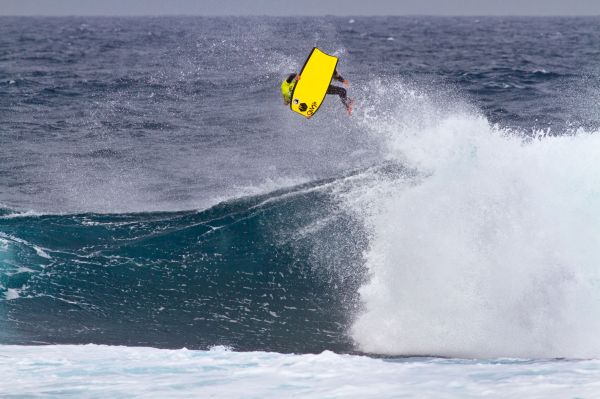
How To Bodyboard Reverse Air

How To Do a Reverse Air

1. First pick off a wave that will give you some speed and has a pitching lip or some sort of section to hit. 
2. Then you bottom turn or drive down the line to get your speed.
3. Find the section that has the best looking lip or section to throw you in to the air.
(I like to look for on coming sections with a lip throwing off the foam or come off the bottom off a hollow wave and hit the lip right out of the bowl). 
4. As you hit the lip use it’s power to propel you in to the air and at the same time try and lift you self off the wave and in to your rotation. Think of grabbing your boards nose and rail and lifting them up towards you as you hit the lip.
5. Look back and lift your legs while you rotate, just as you would do on a normal reverse.
6. Then try to keep your legs together as you complete your spin.
7. As you land hold on and engaged your legs so you won’t slip out or so you can complete your spin in the white water.
8. Practice doing reverses and reverses off the foam to get the motion right if the waves aren’t big enough. 
Enjoy

How to Bodyboard Air Roll Spin ARS

How to  Air Roll Spin ¬ ARS 
1. Take off on any wave that provides a pitching lip. 
2. Travel down the face gaining speed towards the lip of the wave. 
3. As you get closer to the lip angle your board upwards in a angle to hit the lip. 
4. As you make contact with your board against the lip you should feel the wave pushing you out in to the air, if the lip does not seem to put you in the air you will need to use your arm strength to pull your board off the lip so you are free to start your move. 
5. As you get pushed out in the air arch your head and back and start your roll. 
6. As you are come out of your roll throw your body in to a spin towards the face of the wave. 
7. As you spin you will either:
    a). Land backwards facing the water as the wave did not have enough power to push you all the way around and you will have to finish the remainder of the spin as you normally would do on a wave. Or the other option is 
   b). That you will have completed the whole spin in the air and will have to land holding on to your board tight, then engage your rail and try and get speed for your next move. 
8. The more you practice this move the better you will get at it and soon you will be doing it in one complete motion and on waves of any size.

How to Bodyboard invert air

How to do  invert air
1st. -Make sure you get a wave that is going to give you some speed the more the better. If the wave has a wedge in it or has a steep take off   or has some size you will be able to generate speed a lot easier.
2nd.  -Drive off the power pocket of the wave to use what ever speed the wave has. Some time the power pocket is at the bottom and some times it is at the top. Where depends on the type of wave.  A wedge, or really steep wave has a power pocket more at the bottom which lets you drive off your bottom turn towards the lip and   regular waves have the power pockets higher up and you have to stay high and race towards the lip from there.
3rd. -You are racing towards the lip with all the speed the wave can give you.
Have to see where the lip is pitching and aim at it.  It helps to hit the lip at the same moment it throws out. To early and you go flying off the back, to late you get stuck in the lip and sent to the bottom, but if you hit it just right you get sent soaring in to the flats like a champ.
4th. -You hit the lip at just the right time now and throw you body and board off of the lip and in to the air.
5th. -Now is the right time to tweak your board and body in to a inverted position, this means the bottom skin of your board should be facing straight up towards the sky and your head should be looking down to where you intend on landing.
6th. -As you land, try and land on the foam if you can to cushion your landing, or if you get thrown in to the flats like you want, relax and hold on, flatten out as you hit the water so the shock is absorbed equally by the whole board.
Advanced tips - once you have mastered the regular invert try letting the wave throw your body out at a 180 degree angle as you invert and this will make the move look even more radical.
Now go out and hit some lips and practice boosting big!

Bodyboarding Workout (Bodyboard)

Everybody has there own approach to working out.  Even the top ranked bodyboarders on the IBA world tour have their own personilized training routines.  There are plenty of workout disciplines available to help improve your bodyboarding including some of today's more popular approaches with Yoga, Swiss ball, Russian kettle bells, and Brazilian jiu jitsu/MMA (mixed martial arts).  For exercises that are a little more bodyboarding specific, though, click on the link below.
As demonstrated in the video link above, incorporating the use of a Swiss ball in your workout can definitely help:


Stretching for Bodyboarders (Bodyboard)


Stretching is one of the most important variables in top bodyboarding performance. You can find critical differences after undergoing a stretching plan for a few weeks.

Duck dives, vertical drops, huge ARS and Rollos have impact in your body. Injuries come you cannot handle hard landings and tough movements. That's when stretching comes with very positive results.
There are many ways to get your body more elastic. If you're willing to spend 30 minutes a day with a few simple stretching exercises, your muscles will deliver completely new performances out in the waves.
Pro bodyboarders are always stretching in order to keep a healthy daily habit. Some riders say they can reach stretching routines of up to six hours/day, while watching TV or relaxing in the garden.
The good side of it is that you can stretch your body almost everywhere. Get a towel or a simple carpet and apply a few stretching techniques for 15 minutes. Hold the positions for as long as you can.
In the first week of physical exercise, you'll notice improvements. Flexibility is the result of constant and sustainable stretching. Your legs and torso need to be used to a conditioning program. So, add a few strength and endurance exercises.
For the everyday routine, start by doing a forward and lateral neck stretch, a crossover twist and crossed knee lift. Then advance to 15 abdominal crunches, 10 burpees and 15 forward lunges. Add a 10-minute paddle in a longboard and walk for 20 minutes.
Frequency and repetition are critical to a rapid body development. As time goes by, you can jump to a new level with push-ups, bench dip, split squat, stair climbing, mad cat stretches, arm circles, torso rotation, running, underwater swimming and quadriceps stretch.

Now Start Bodyboarding (Bodyboard)

If you're reading this, you probably have a new bodyboard or "sponge" and you're ready to get out there and start tearing it up in the water! Check out some of these steps to get you out there and gliding across double overhead barrels in no time!
Paddle out. Your hips should be on the tail of the board; your hands should be on top of the board, and your elbows should be on the board instead of in the water. Kick your feet, making sure to keep them underwater.


Catch a wave. Turn your back to the wave and kick your feet. Keep your back arched and your head up.


Control and steer the board. Choose to turn right or left. Turn right by shifting your body to the right side of the board and grabbing the top of the board with your right hand, elbow lying on the board. Place your left hand approximately in the middle of the left side of the board, left elbow in the air. Your right side’s purpose is to keep your board in the wave; your left side is controlling the direction of the board. Turn left by doing the opposite.

Choosing Fins and wetsuit (Bodyboard)

step 2
Pick out booties and swimfins. Booties are like socks and make the fins fit better. It is almost impossible to bodyboard without swimfins, notes the Saltwater Dreaming website. Fins help you with every aspect of the sport: paddling out, catching waves, and controlling and steering the board.Acquire a wetsuit if you will be bodyboarding in cold water. A wetsuit provides insulation and makes your bodyboarding experience more comfortable. Choose a wetsuit that fits snugly and allows movement. A too-loose wetsuit lets in water and will not keep you warm.

Your choice will depend on the temperature of the water and your use


CHOOSING YOUR WETSUIT BASED ON THE WATER TEMPERATURE


Subscribe to our Newsletter

Contact our Support

Email us:fasoudilka@gmail.com

Our Team Memebers